When Women Take the Floor in Global Land Governance
At CRIC23 in Panama, financial support, negotiation training and networking opportunities helped women delegates participate more actively in international land and climate discussions
The Added Value of This Article
Hover over to have a look!Value add for readers
- You gain practical insight into how combining financial support, capacity-building, and networking can effectively increase women’s participation and influence in multilateral processes.
- The example of CRIC23 offers a replicable model for designing initiatives that remove structural barriers and strengthen meaningful participation in international policy settings.
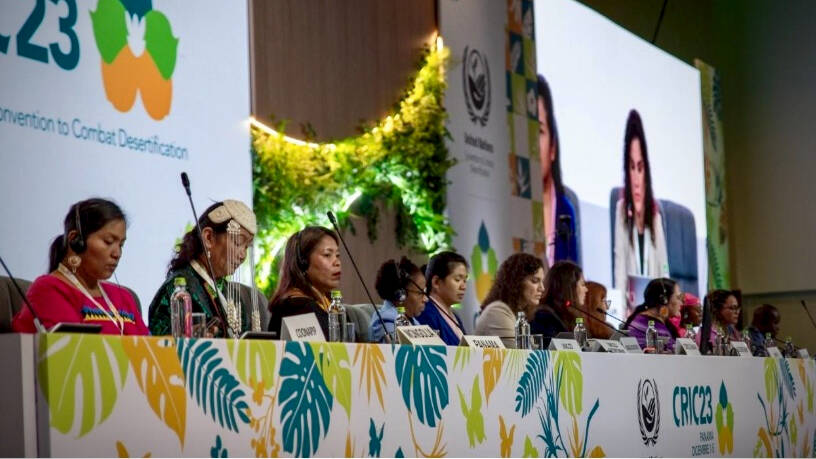
CRIC23 Gender Caucus panel ⎮ Photo: © IISD/ENB
At CRIC23 (Committee for the Review of the Implementation of the Convention) of the United Nations Convention to Combat Desertification (UNCCD), held in December 2025 in Panama, several targeted measures to strengthen women’s participation came together. These included financial support for conference attendance through the UNCCD Women Delegates Fund, preparatory training ahead of the conference, and exchange and networking formats during the session week. The aim was to increase the visibility of women delegates and strengthen their active participation in UNCCD sessions and working processes.
Herivelo Dina Michel Ranaivo is Co-Lead for Madagascar in the UNCCD Working Group on Climate Change and Desertification, where she contributes to COP preparations, the integration of the gender perspective, and planning for drought response. She is also an Advocacy Officer in the civil society network ROHY – MSIS TATAO. Her participation in CRIC23 was supported through the UNCCD Women Delegates Fund.
Regarding CRIC23 and the support provided by the Fund, Ranaivo said:
“The CRIC23 and the negotiation training helped me greatly to navigate confidently in an international, multicultural environment, to exchange experiences, and to develop strategies together. It was especially valuable for me to learn how we can combine our strengths through joint negotiations to advance the implementation of the Convention. I would like to share the knowledge I gained in Madagascar—especially with women in rural and vulnerable regions—to strengthen their negotiation skills, resilience, and adaptation to current challenges.”
The United Nations Convention to Combat Desertification (UNCCD) is the central international agreement to combat desertification, land degradation, and drought. It links ecological objectives with sustainable development and social participation.
Within the framework of CRIC23, women’s participation in multilateral environmental processes moved further into focus. The measures implemented aimed to reduce structural barriers to access and promote equal participation in international decision-making and implementation processes.
Addressing Structural Barriers to Participation
To date, women have made up only around 30 percent of delegates at UNCCD sessions and are therefore significantly underrepresented. The UNCCD Women Delegates Fund addresses this structural gap. The Fund was financed under the global programme Women’s Empowerment for Resilient Rural Areas (WE4R) and supported women delegates in attending official sessions of the Convention. In parallel, the European Commission implemented its own comparable project to promote women’s participation.
The Fund focused on removing financial barriers to participation, thereby addressing a key obstacle to access. Within the UNCCD, gender equality is considered a prerequisite for effective and sustainable measures to protect and restore land. A key indicator in this context is gender parity—that is, the balanced representation of women and men in decision-making and policy bodies.
Figures show that at CRIC23, 123 of 251 delegates were women (around 49%). Compared to previous CRICs and COPs, this represents significant progress: for example, at CRIC21 the share of women was still 33 percent. While these figures are based on participant registrations and may change slightly in the final evaluation, they already demonstrate the positive impact of targeted support.
The programme supporting the initiative worked with the 3R approach (Rights, access to Resources, and Representation). In the context of CRIC23, participation support was complemented with preparatory capacity-building measures.
Preparing Delegates for Multilateral Negotiations
A training specifically prepared delegates for CRIC23. It took place before the start of the conference and was aimed at women delegates from different institutional and regional contexts.
The approach combined technical inputs with simulations, exchange formats, and structured reflection phases. In addition to thematic orientation, the focus was on communication skills, strategic positioning, and navigating group dynamics. The objective was to strengthen delegates in their roles and increase their confidence in negotiations and working formats during CRIC23.
The shared learning space fostered exchange among participants and enabled targeted preparation for the session week.
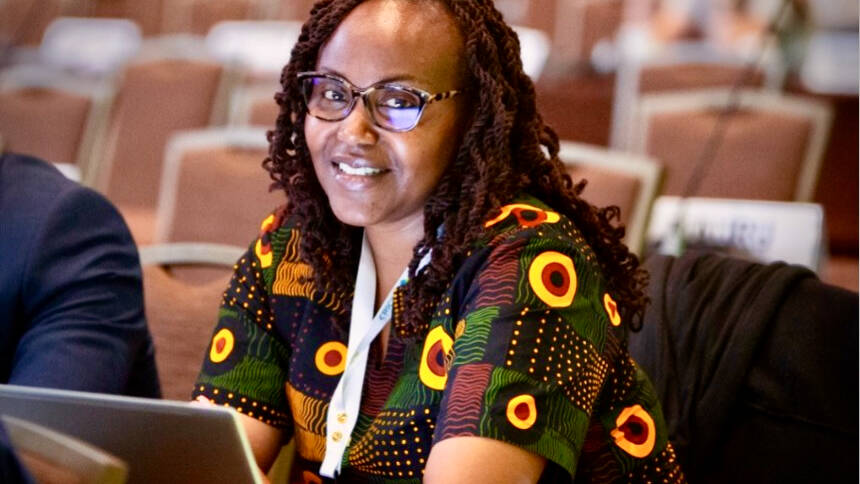
Lilian Torome, Environment Officer at the State Department for Environment and Climate Change (Ministry of Environment, Climate Change and Forestry, Kenya), whose participation was financed through the Women Delegates Fund.) ⎮ Photo: ©IISD/ENB
On the importance of the negotiation training, Lilian said:
“Women are often told they do not belong where decisions are made. The training showed me: negotiation is achievable—and women belong at the table. It is never too late to make our voices heard. My message to all women: we are coming!”
From Attendance to Active Participation
The combination of participation support and preparatory capacity-building proved effective during CRIC23. Many women delegates actively took the floor, contributed to discussions, and positioned themselves visibly in working groups and discussion formats.
An accompanying networking side event complemented the conference. The event was organized by the European Commission, WOCAT, and WE4R and brought together women delegates, representatives of international institutions, and partner organizations.
A panel with high-level representatives from the multilateral context opened the exchange on experiences and structural conditions shaping women’s participation in international environmental processes. Structured networking formats subsequently provided space for in-depth discussions and relationship-building.
Lessons from CRIC23
The experiences surrounding CRIC23 show that financial support, preparatory capacity-building, and structured networking can reinforce one another effectively. Together, these measures strengthened not only the presence of women but also their active role in shaping multilateral environmental processes under the UNCCD framework.
Figures on gender parity underline this progress: around 49% of delegates were women—the highest figure for a UNCCD CRIC session to date and an important step toward the goal of equality by 2030. The results highlight the importance of instruments such as the UNCCD Women Delegates Fund, financed for CRIC23, as well as complementary trainings and networking formats.
Contact
Andreas Lange, Head of Project, andreas.lange@giz.de
