Private Sector Challenges to Unlock Food Systems Transformation
How women-led agrifood businesses in Zambia lead the way to better nutrition, climate resilience and jobs
The Added Value of This Article
Hover over to have a look!Value add for readers
1. What this evidence means for decision-makers
-
For policymakers, this analysis identifies where regulatory reform can unlock private sector growth.
-
For development programmes, it shows where business support systems fail to reach companies.
-
For investors, it highlights sectors where market potential already exists but remains constrained.
2. What drives transformation in practice
Women-led agrifood enterprises already demonstrate viable pathways toward nutrition-sensitive, climate-resilient and employment-generating food systems — but their growth depends on functioning markets, accessible finance and supportive business ecosystems.
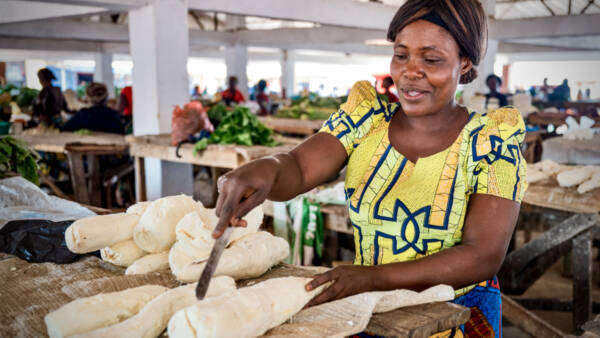
Food and Nutrition project in Zambia ⎮ Photo: © GIZ
Zambia’s food systems transformation will not be driven by policy reform alone. The country’s agrifood economy already shows where change is actually happening — inside businesses that produce, process and distribute food every day. A recent business survey covering ten districts in six provinces reveals both the structural barriers that limit private sector contribution and the concrete opportunities to unlock nutrition, climate resilience and employment. Speaking to a few CEOs and a women organization in Zambia reveals that women-led agrifood enterprises are very much at the centre of this shift, demonstrating what transformation looks like in practice — if the surrounding system allows them to grow.
Business environment constraints in Zambia’s agrifood sector
Around two billion US dollars of additional funding per year over a decade could be enough to end hunger in Zambia by 2035 if resources are used efficiently. However, in view of shrinking development budgets and tight fiscal leeway of governments in many countries, private sector investment must be mobilised more deliberately (Hesat 2030). Without higher investment, healthy diets will remain unaffordable for more than 80 percent of the population. Zambia has recently embarked on groundbreaking policy (reform) processes in the agrifood sector. But there are still many hurdles in the overall business environment, a recent analysis by the Scaling Up Nutrition Business Network demonstrates. Private enterprises, from farmers, via processors, traders and retailers, are a lever in food systems transformation: they increase productivity, food and income security, and climate resilience. Policy must therefore focus more on reducing systemic barriers to unlock the full potential of the private sector. The GIZ Global Project Transformation of Food Systems and the World Food Programme supported the Scaling Up Nutrition Business Network analysis of 225 agrifood companies in ten districts of six provinces of Zambia. The survey highlights systemic barriers such as limited access to land, financing, technology, jobs, and decision-making spaces.
Structural weaknesses along the value chain
The Scaling Up Nutrition Business Network survey shows several vulnerabilities along the value chain. There is a high level of business formalisation (94.2 percent registered), with private limited companies and sole proprietorships dominating in the Zambian agrifood economy. At the same time, formal contractual relationships between business partners are glaringly rare, about 12.9 percent in retail and 11.1 percent in processors. This reduces predictability, quality assurance and financing options, thus increasing vulnerability of market actors. Supply chains are fragmented, often with a high level of reliance on smallholder farmers. Cooperatives hardly play a role in the overall picture, which could otherwise strengthen the bargaining position of small-scale farmers and producers. The focus of value creation is downstream in processing and trade, while upstream areas such as input supply and primary production are underrepresented. Processors therefore play a key role in market linkages for farmers and employment. In the companies surveyed, more than 6,000 full-time positions are filled, but with a clear gender gap: only 30 percent are women, around 1 percent are persons with disabilities. Seasonal employment is widespread with income instability as a possible consequence.
Sales channels remain strongly local. More than half of sales take place in local markets, with less than a fifth each in retail and wholesale. Processed products dominate in retail, with only a few of the product ranges being classified as healthy or fortified by the respondents. Only very few also use health and quality labels such as the Good Food Logo. In processing, the focus is on packaging; advanced processes such as drying or canning are less common. Distributors are shifting from raw materials to processed and chilled products, but fresh produce remains underrepresented due to high logistics costs, poor roads and a lack of cold chains. Nutrition awareness among businesses is divided. About 50 percent are familiar with nutrition-sensitive practices, and understanding is high among those informed. The main obstacles to a wide range of healthy products are limited demand, limited outreach capacities, lack of support and funding. Nevertheless, there is interest among businesses in instruments such as labelling, improved packaging, campaigns and fortification.
Taken together, these patterns show that Zambia’s agrifood system is not constrained by lack of entrepreneurial activity but by weak coordination mechanisms across the value chain.
Climate risks and financing barriers
Almost all companies confirm negative climate impacts, especially rising costs, supply disruptions and productivity declines. While renewable energies, diversification and climate-smart practices are often used as adaptations, insurance and formal business continuity plans are not very common. Less than half of the companies actively sought financing, but attempts via the Constituency Development Fund, banks or microfinance led to no access in more than a third of the cases. Low approval rates and a lack of feedback deter small businesses, particularly those run by women or young people. Gaps persist in access to business development services, with more than half having no access, and quality of existing services being heterogeneous. Access to information is mainly received via peers, radio/TV and social media. Extension services, on the other hand, reach only a smaller part.
These structural barriers are not abstract constraints; they directly shape which businesses can grow and which innovations reach the market. Women-led enterprises in particular are already navigating these constraints while demonstrating new models of nutrition-sensitive and climate-resilient production.
Women entrepreneurs driving practical innovation
Several outstanding examples show how women in Zambia already drive transformation, for instance as entrepreneurs, despite challenging conditions. One of the women-led businesses for example has professionalised a range of nutritious cereal porridges based on sorghum and millet in less than ten years. Today she markets her products both via large retailers as well as micro-shops on the roadside that are usually known to provide mobile phone services to deliver products in areas that are convenient for low-income households. With around 5,000 smallholder farmers in the supply chain, she emphasises the relevance of systemic investments from production to waste management, consumer education on healthy diets, as well as climate-resilient crops and soil health.
Another female CEO of a company that processes sorghum, millet and cassava reports having overcome raw material and financing bottlenecks, partly through non-governmental organisation funding for cleaning technology and farmer training. This allowed her to tap into supermarket chains and improve branding and certification, which also provided access to bank loans. With around 500 suppliers in remote regions, she observes the climate resilience advantages of sorghum and millet over maize. She says she sees a change of mindset in many consumers who are willing to adjust their eating habits and not only utilise maize meal in their kitchen. Being able to deliver to all big chain stores in the country, she also sees export opportunities and innovation potential, e.g. with orange-fleshed sweet potatoes.
Nkonka Women in Agro Business is a Zambian organisation that works to empower both women-led organisations and youth to develop business skills. For example, Nkonka provides capacity building for young farmers and entrepreneurs to run their own organisations, access funding and strive to improve value addition on the farm. Talking to a member of the organization she says she advocates for a shift in mindsets, finding that agriculture is not yet sufficiently perceived as real business and an opportunity for entrepreneurship. Therefore, she supports early involvement of young people and technology-enabled approaches. She highlights that networks and peer learning are crucial for this.
Policy implications for scaling transformation
The findings point less to the need for new strategies than to the implementation of existing policy commitments through functioning market institutions and business support systems. Underlining the Scaling Up Nutrition Business Network analysis, these examples highlight the potential of women-led agrifood companies to drive better nutrition, climate resilience and employment. Reliable market access, suitable financing instruments, cooling and processing capacities, quality and standard fulfilment, as well as accessible, practical business development services and functioning networks are crucial.
For businesses to thrive, the reduction of regulatory transaction costs and the strengthening of district-related services and contractual capacity is needed. Affordable and simplified financial solutions and quality-assured business development support with a focus on women, youth and rural businesses should be one of the key policy priorities. Combined with systematic anchoring of nutrition in value chains through fortification, labelling and demand promotion and the expansion of climate-smart practices, improved infrastructure, early warning and insurance solutions, there is a great potential to make substantial progress on food systems transformation.
Additional information
Mapping and Needs Assessment Report (of businesses), Scaling Up Nutrition Business Network Zambia.
Contact
Klaas Grimmelmann, Project Component Manager, Global Programme on Food Systems Transformation, Zambia