When Extreme Uncertainty Becomes the New Normal for Food Systems
Disruption or transformation? With the new Strategic Foresight Report for Agriculture and Food Systems, GIZ looks into future scenarios for the post-2030 era
The Added Value of This Article
Hover over to have a look!Value add for readers
- Understand how strategic foresight can be used to think beyond project cycles and explore plausible futures for agriculture and food systems under conditions of growing uncertainty.
-
Gain insight into four contrasting future scenarios and how they can inform strategic choices in policy-making, investment, and international cooperation.
-
See how foresight approaches help connect sectors and perspectives, supporting more integrated responses to complex, long-term challenges.
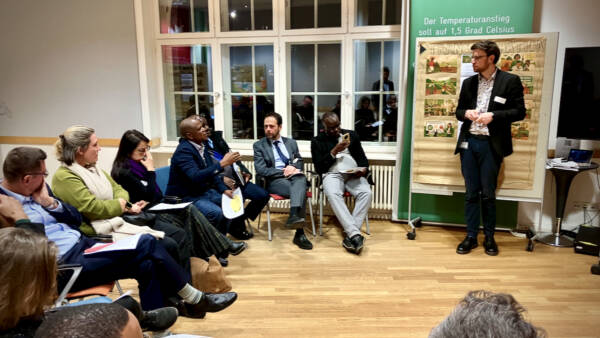
Group work during the international workshop ⎮ Visual: © Claudia Jordan/GIZ
What the future of agriculture and food systems may look like is no longer only a matter of speculation; it’s a key strategic question. Against the backdrop of geopolitical tensions, climate risks, and shifting global priorities beyond 2030, strategic foresight is increasingly used to explore plausible futures and test today’s decisions against tomorrow’s uncertainty.
GIZ’s new Strategic Foresight Report on the Futures of Agriculture and Food Systems sketches out four scenarios to support longer-term thinking in policy and international cooperation. It was presented during an international workshop at their Berlin Representation in January. The plausible scenarios offer a glimpse into the future that allowed to develop strategic responses for stakeholders in agriculture and food systems, and for international cooperation.
Strategic Foresight as a tool to navigate uncertainties
“Feeding the world by 2050, reducing poverty, and protecting the environment will only be possible through strong international cooperation and forward-looking action”, said Nina Theis, who is heading section G510, Agricultural Systems and Agriculture Supply Chains. “Yet what we have clearly seen is that many global ambitions to end hunger and poverty are at a crossroads. Extreme uncertainty has become the new normal,” she added.
Moritz Hunger, member of the Foresight Team of the Corporate Development Unit at GIZ, together with the Sector Project Agriculture, used expert input and generative artificial intelligence to develop four plausible futures for agriculture and food systems until 2035. The themes and methodology archetypes included growth, collapse, discipline and transformation. GIZ will pilot the foresight method in selected consultations with BMZ and support partners and colleagues in partner countries in using it.
Scenario Feeding Growth (Growth)
Automation is growing rapidly while rural employment is collapsing. Diets are increasingly unequal and there is plenty of cheap ultra-processed food around, while elites adopt personalised longevity diets. The system that produces food is undermining its social and ecological resource base.
Scenario Fractured Futures (Collapse)
Production in major breadbasket regions has collapsed due to the passing of severe climatic tipping points. The slowdown of the Atlantic Ocean currents is irreversible. Food is weaponised in geopolitical and local conflicts. Armed groups and militias control fertile land and water. There is no agreement on the Post-2030 Agenda. The global agriculture and food system has collapsed.
Scenario Controlled Stability (Discipline)
Government-managed nutrition systems replace individual food choices. The social pressure on consumers rises, food loses its cultural aspect. Citizens receive digital food credits tied to emissions and health metrics.
Scenario Regenerative Transformation (Transformation)
Agroecology and biodiversity-friendly practices become global standards. Investments align with soil restoration, ecosystem repair, and healthy diets. Data has become a public good that fuels inclusive and decentralised innovation.
The workshop brought together policymakers, development practitioners, researchers, the private sector, and civil society. Among the participants were international partners of the Partners for Change (P4C) network, the Food and Agriculture Organisation of the United Nations (FAO), and the Federal Ministry for Economic Cooperation and Development (BMZ).
“Even with many open questions about the future of multilateralism, I am convinced that it is worth investing our energy in a post-SDG agenda that places agriculture and food systems at its core,” said Jochen Renger, Director of GIZ’s Sectoral Department (FMB) for Climate Change, Rural Development and Infrastructure.
Transformation is the most desired but also the most ambitious scenario
Surprisingly, many workshop participants discovered that elements of all four scenarios are already a reality. They agreed that to make the transformation scenario come true, stakeholders would need to be open-minded and share a common optimistic view.
“All four scenarios relate, in different ways, to a post-SDG agenda”, said Jochen Renger, on the closing panel. “The choices we make now can steer us toward very different futures.”
He added that strategic foresight helped break down silos and moved toward integrated solutions. It was an increasingly important tool for development cooperation, as the recently issued BMZ reform plan Shaping the future together globally stated.
Crises and shocks as levers for positive change
However, crises and shocks can also have a positive impact on future agriculture and food systems, as Permanent Secretary of the Zambian Ministry of Agriculture, John A. Mulongoti stressed in the closing panel discussion. Disruptive events like the severe drought in Zambia in 2024 had brought positive change and learning. The support to farmers who are affected has also become more targeted by means of new technologies.
Furthermore, after Russia’s war against Ukraine had disrupted wheat and fertiliser supply chains, Zambia adapted its agri-food strategies and has turned out to be stronger after the crisis: Nowadays, Zambia is not as dependent on foreign suppliers as it was before, and is furthermore exporting fertiliser and maize to its neighbours and the region.
Contact
Please reach out to the GIZ team should you like to receive the scenarios for strategic workshops with your team or organisation.
- Gerd Fleischer, gerd.fleischer@giz.de
- Maike Möllers, maike.moellers@giz.de
- Moritz Hunger, moritz.hunger@giz.de
