District Food Systems Steering Committees Take Root in Malawi
A bottom-up approach is helping districts strengthen coordination, map food systems actors, and build more functional local governance for healthier diets
The Added Value of This Article
Hover over to have a look!Value add for readers
- See how district-level food systems steering committees can turn multisectoral coordination into a practical governance tool.
- Learn how food systems mapping helps identify key actors, infrastructure gaps, and barriers to healthier diets.
- Take away a bottom-up model that can inform wider food systems planning and replication.
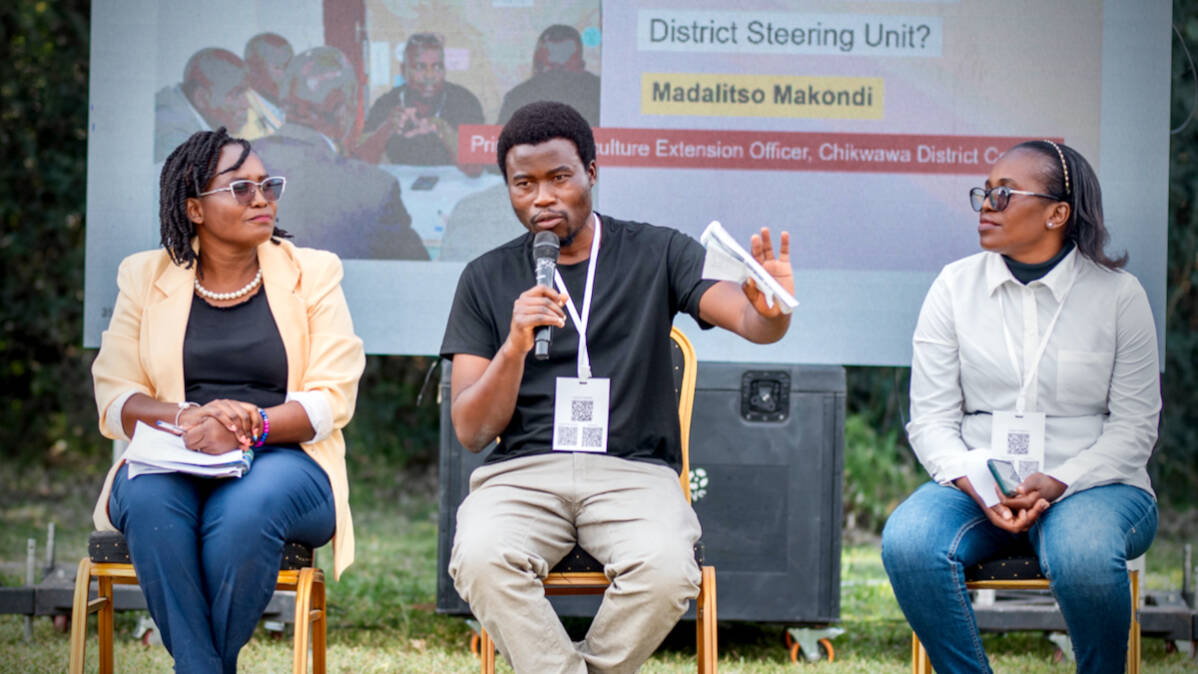
The three districts sharing information on benefits ⎮ Visual: ©GIZ/STEP UP project
Across Malawi, elders often use the words Mutu umodzi susenza denga” — one head alone cannot carry the roof of a house. For too long, however, the house of Malawi’s food and nutrition security has often been built from the top down. A house built this way struggles to withstand the pressures of climate change, unhealthy food environments, biodiversity loss, weak coordination, and poor policy implementation. These pressures, in turn, undermine the sustainability of otherwise promising interventions.
Food systems thinking shows that meaningful change often starts in the richer realities of districts and municipalities. Approaches tested at district level can help break persistent silos at national level and strengthen efforts to place healthy diets at the centre of food systems transformation. The STEP UP! project — Supporting the Transition of Food Systems in Malawi — commissioned by the German Federal Ministry of Economic Cooperation and Development (BMZ) and implemented by GIZ Malawi, is supporting the districts of Chikwawa, Dedza and Mzimba to establish multisectoral stakeholder platforms that foster inclusive governance and advocate for healthy diets.
From top-down planning to district-rooted governance
Through collaboration and dialogue among state and non-state actors, a series of workshops led to establishing district food systems steering committees — multi-stakeholder platforms where different sectors come together to coordinate food systems interventions.
To ensure these platforms were both innovative and inclusive, the districts first conducted a rigorous SWOT analysis of the model. They looked to Dedza District as a reference point. There, a task force established by the GIZ Global Transformation of Food Systems project had already succeeded in bringing together civil society, government, religious leaders and local authorities. This experience provided a practical foundation for shaping the steering committees into functional governance units.
These committees are not simply platforms on paper. With support from STEP UP!, they convene cross-sector representation and address issues affecting each district’s food system. Their work spans governance, gender inclusion, healthy diets, evidence generation, and the translation of that evidence into more resilient food systems action.
The committees operate within the existing district architecture. They report to the District Executive Committee and bring together sector technical working groups and committees working on food-systems-related issues. These include technical working groups in agriculture, trade, nutrition and health, transport, information, and community development. Standing terms of reference, validated at national level, help ensure central government involvement throughout the process and support future learning and replication.
Food systems mapping as a first test of functionality
An important milestone recently completed by these committees was district-based food systems mapping. The aim was to identify active players across food systems functions in the communities and districts.
The exercise was carried out in all three districts as a first step towards developing concrete implementation plans. It highlighted which stakeholders are essential to the committees’ work. But the exercise went beyond data collection. It also helped reveal the gaps and systemic barriers that shape how food systems actors interact — and how these challenges affect the delivery of healthy diets at household level. The committees are now working on implementation plans to address these issues.
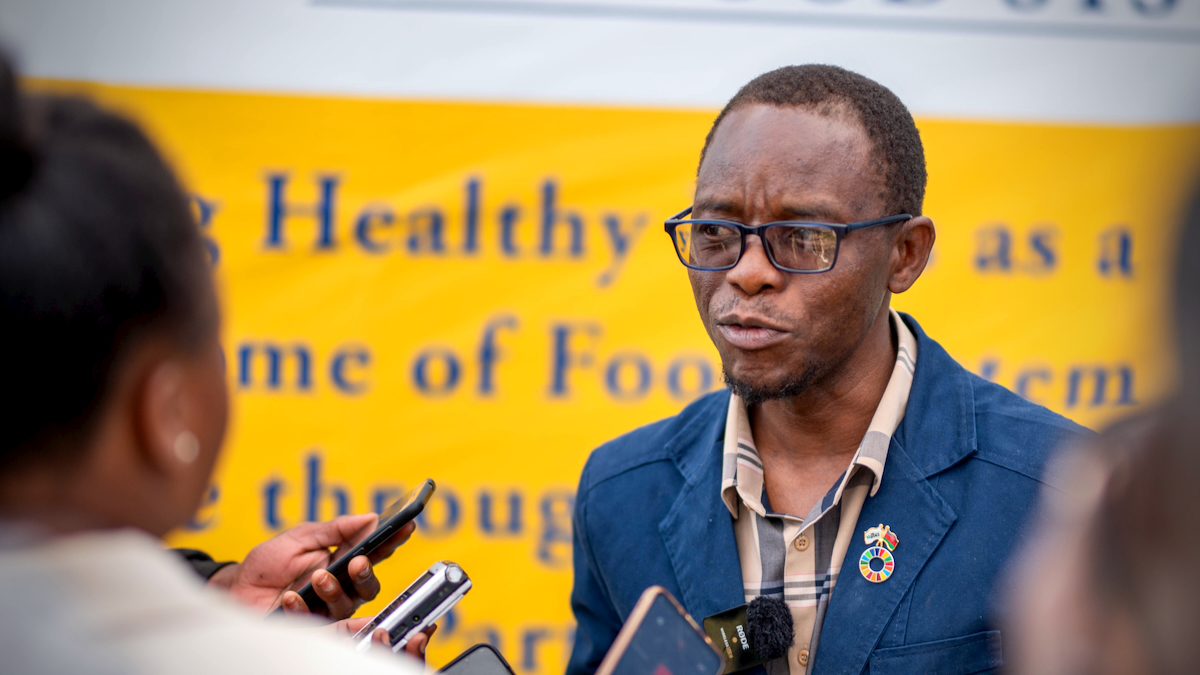
Andrew Jamali talking to the media ⎮ Visual: ©GIZ/STEP UP project
Speaking on the topic, Andrew Jamali, Director for Knowledge and Learning at the National Planning Commission, emphasized that this work was an important contribution to the Malawi 2063 vision:
“The efforts in districts where STEP UP! is working help move food systems beyond a narrow focus on agriculture and connect them more strongly to nutrition and health. This aligns with the Malawi 2063 vision of a food systems approach. I would like to see this scaled up by other partners such as WHH, UNICEF and Fosta-Health in districts like Mangochi, Balaka and Ntcheu, building on examples from places like Dedza. Mapping should go beyond identifying who is active in the system. It should also help track where positive results are emerging, how these can be scaled, and which dimensions need more attention.”
What the mapping revealed
While Jamali highlighted the importance of tracking positive returns through data, the district-level application of the mapping also showed where such returns were being constrained by social barriers.
Liznet Kaduya, Gender Officer for Dedza, explained that the mapping had revealed a major gap: women were heavily involved in labour-intensive food production but were still largely excluded from the more profitable functions of the food system. She noted:
“The mapping found that many women’s initiatives are concentrated in production, with limited decision-making power over outputs due to cultural gender norms and low literacy levels. There is a need for deliberate efforts to strengthen women’s participation across food system functions, including markets and value addition. This can be supported through formal and informal education, improved access to credit, and stronger engagement of men. Making interventions more gender-responsive is key to closing these gaps. Women have a direct influence on household food diversification when they are economically empowered.”
A platform districts can build on
By establishing these steering committees, the districts have shown strong commitment to transforming their local food systems. In doing so, they have turned coordination from a frequently repeated concept into a more practical tool for advancing district development plans.
The food systems mapping exercise also opened a new path to more actively engage actors with a stake in district food systems. Because this bottom-up approach is rooted in district realities, these multi-stakeholder platforms are better positioned to respond to change and to engage relevant stakeholders in an open and practical way.
Contact
- Fyness Chingoma, fyness.chingoma@giz.de
- Trevor Madeya, trevor.madeya@giz.de
