From Pastry-Making to Food Security in Beni
Women survivors of violence rebuild their livelihoods while improving access to affordable local food
The Added Value of This Article
Hover over to have a look!Value add for readers
- Small economic activities and savings groups help women rebuild their livelihoods after conflict.
- Training in pastry-making using local ingredients enables women to generate income while improving access to affordable food.
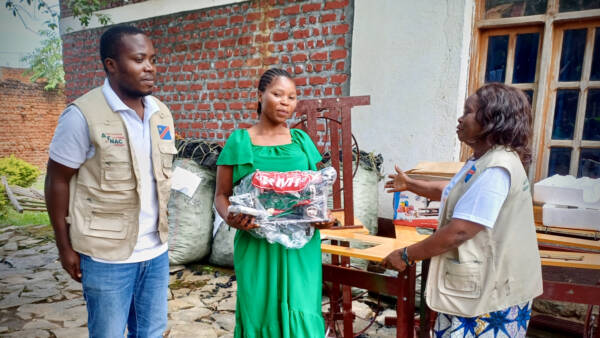
From left to right: Mr. Mardochée NZ, Finance Officer at AFNAC,
Masika and Benge from AFNAC ⎪ Photo:© GIZ
Masika and Benge from AFNAC ⎪ Photo:© GIZ
In and around the city of Beni, in eastern Democratic Republic of the Congo, years of conflict and displacement have weakened the livelihoods of many families. For many women who once depended on agriculture, access to land has become difficult, making it harder to provide food for their households.
In this fragile context, vocational training and small income-generating activities offer new perspectives. The processing and artisanal production of pastries using local ingredients has become a practical solution to strengthen both livelihoods and household food security.
Supporting women’s economic recovery
In Beni, the Association of Women for Community-Based Nutrition (AFNAC) supports vulnerable women, particularly survivors of sexual and gender-based violence, in developing income-generating activities.
Since the beginning of 2026, nearly one hundred women have taken part in these trainings supported by Deutsche Gesellschaft für Internationale Zusammenarbeit (GIZ) through the ProPaix III project.
The approach is based on a simple observation: when women have their own sources of income, the benefits directly support their families. Increased purchasing power allows households to diversify their diets and improve children’s nutrition.
Pastry training using local products
At the Beni Vocational Training Centre, participants receive practical training in several activities, including soap production and the artisanal processing of food products. Among the most popular activities is the preparation of bread, cakes and doughnuts.
Using locally available ingredients such as cassava flour, wheat and sweet potatoes, the women learn how to transform these agricultural products into foods that can be sold in local markets.
According to Benge Mukengere, coordinator of AFNAC, these skills both create economic opportunities and improve access to food within the community.
Processing local agricultural products into pastries allows families to buy food at affordable prices while reducing dependence on imported products. At the same time, the women can generate income through their small commercial activities.
The programme also includes nutrition awareness activities for pregnant women, breastfeeding mothers and families with young children.
One beneficiary explains: “The training taught me to prioritise my children’s nutrition through the income from my activity. I now understand that a balanced diet contributes to their growth.”
Conflict and displacement worsen food insecurity
For more than a decade, the Beni region has experienced an escalation of violence linked to attacks by the Allied Democratic Forces, an armed group active in eastern Democratic Republic of the Congo.
The resurgence of hostilities at the beginning of 2025 caused new waves of displacement, forcing many families to abandon their agricultural land and sources of income.
Today, the urban areas of Beni host a large number of displaced households, many of whom previously relied on agriculture. The concentration of vulnerable populations, combined with persistent insecurity, increases pressure on local resources and contributes to rising food insecurity.
According to the Integrated Food Security Phase Classification analysis published in October 2025, the situation remains worrying. By mid-2026, more than four million children under the age of five and around 1.5 million pregnant or breastfeeding women could be affected by malnutrition in the Democratic Republic of the Congo.
Reintegration kits to rebuild livelihoods
To support the economic recovery of trained women, assistance is also provided for starting small commercial activities.
In February 2026, 55 women received reintegration kits tailored to their activities. These included bags of flour, oil and charcoal for pastry-making, sewing machines for tailoring, and bundles of clothing for small-scale trade.
Before launching their businesses, participants also receive training in management and organisation of income-generating activities to ensure the sustainability of their initiatives.
In addition, several women join Village Savings and Loan Associations, community savings groups that strengthen members’ financial security and help them better cope with economic shocks.
Through these initiatives, the women of Beni are gradually rebuilding their livelihoods while contributing to improved food security for their families and communities.
Contact
Eliane Polepole, Technical Expert in Peace Journalism, ProPaix III Project, Bukavu, Democratic Republic of the Congo, eliane.borauzimapolepole@giz.de
