Building Food Systems Governance: Working Through Existing Institutions
Zambia’s pathway from policy ambition to coordinated action on the ground
The Added Value of This Article
Hover over to have a look!Value add for readers
-
Understanding the layered challenges of shaping food systems governance
-
Learning how existing institutions and localized initiatives can support this
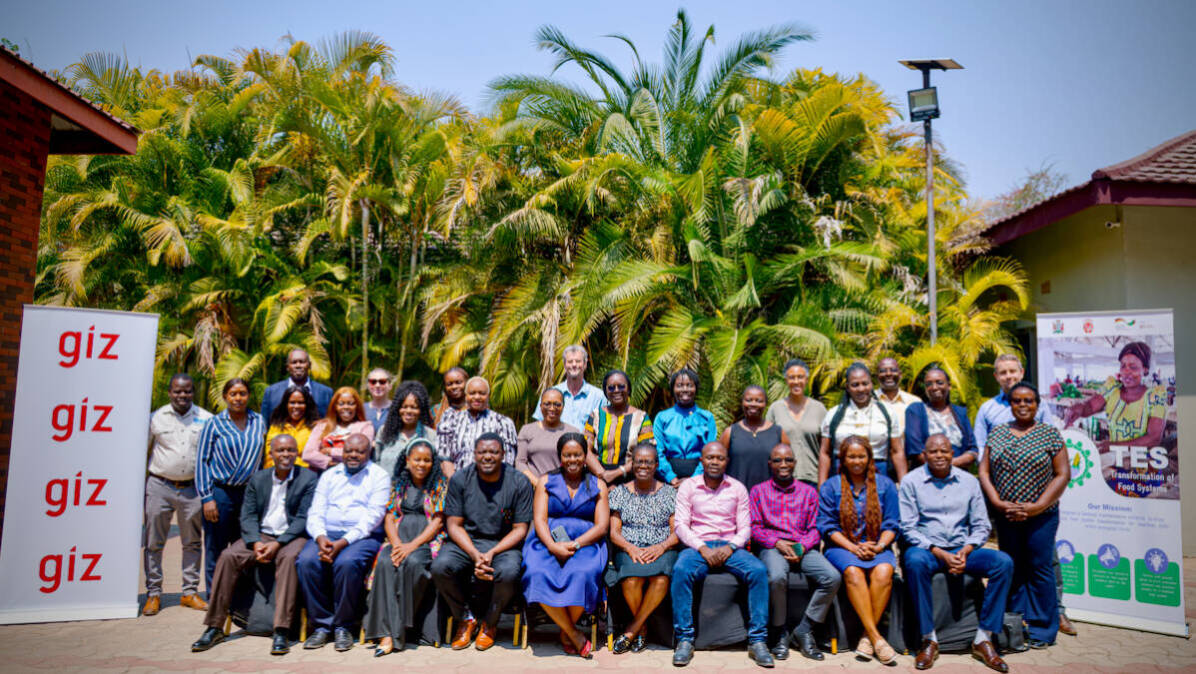
Food Systems Technical Working Group, October 2025 ⎮ Photo: © GIZ
Countries do not build food systems governance from scratch — they build it by aligning what already exists. Zambia’s experience shows how global commitments on food systems transformation are translated into practice by working through established institutions, testing coordination mechanisms, and adapting implementation across national and local levels. For practitioners, the key question is not how to design the perfect governance model, but how to connect policies, actors and structures that are already in place — and make them work together more effectively.
What this means in practice 👉
Zambia’s experience highlights several practical insights for strengthening food systems governance in real institutional settings:
- Governance is not designed; it’s aligned. Progress depends less on creating new structures and more on connecting existing institutions and mandates.
- Implementation fails where coordination is unclear. Policies and pathways only translate into action when roles, responsibilities and reporting mechanisms are defined across sectors.
- Subnational uptake determines impact. National commitments only matter when they are grounded in functioning coordination mechanisms at provincial and district level.
Why food systems governance is a process, not a blueprint
Effective food systems governance is key to ensuring a coordinated approach to implementing ambitious actions across multiple sectors to tackle food and nutrition security, prosperity and livelihoods in the agrifood economy, and climate challenges. There is, however, no blueprint on how to establish it. Rather, it tends to be a process with many junctions that requires careful testing and adjustment in line with existing institutional settings.
The UN Food Systems Summit in 2021 and the subsequent process of biennial stocktaking, as well as the Kampala Agenda with the CAADP Strategy and Action Plan (2026–2035), provide a pathbreaking global and continental policy framework to tackle the complex challenges of rural development, food and nutrition security and agriculture in a comprehensive, systemic and integrated manner.
Addressing complex policy issues, however, requires complex approaches — and translating these into action naturally raises many governance-related questions. Who leads the process? Who is responsible for which part of the agenda? How does this relate to existing policy agendas across sectors? And how is it received at the local level with contextualised needs and capabilities?
The food systems governance landscape in Zambia
Recent research by Patay et al. (2025) maps national-level multisectoral governance institutions for food systems. Analysing 197 countries, the study identifies 34 such mechanisms. Among these, Zambia is one of 20 countries with a governance institution that both spans multiple relevant sectors and integrates non-state stakeholders. It is the only country in the Southern African subregion, with Ghana, Ethiopia and Uganda, among others, being further examples on the continent.
In line with the UN Food Systems Summit, Zambia developed its national Food Systems Transformation Pathways in 2022. Since then, it has made considerable strides in advancing the agenda at the national level. Leadership of the Office of the Vice President, with its supra-sectoral authority, and the National Food Systems Convenor ensures strong convening power with sectoral government ministries. The National Food and Nutrition Commission, as an established multisectoral institution, has been tasked with coordinating the implementation of the national pathways.
The Global Programme on Food Systems Transformation supports the National Food and Nutrition Commission in developing coordination mechanisms and engaging multiple actors. In collaboration with partners from the Transformative Initiative Zambia — including the SUN Business Network, led by WFP, the SUN Civil Society network, FAO and GIZ — the National Food and Nutrition Commission launched the Food Systems Technical Working Group in early 2024 to guide implementation. Since its inception, the National Food and Nutrition Commission, in its secretarial function, has worked with the Food Systems Technical Working Group to draft a monitoring and evaluation framework to support implementation and has required sectoral ministries to submit quarterly progress reports.
Anchoring the food systems agenda in the field of food and nutrition security has facilitated quick uptake by existing networks of the Scaling Up Nutrition Movement, with many other stakeholders positioning themselves to align their work with the national pathways.
Aligning governance building blocks
This approach relates to several of the building blocks of multisectoral food systems governance institutions identified by Patay et al. (2025), including advocacy and dialogue, technical advice, policy coordination and implementation, as well as monitoring. The authors underline, however, that their research does not indicate which number or combination of building blocks is most effective.
Despite considerable progress in Zambia, important building blocks are still missing or need to be strengthened. There are well-known challenges in the field of food and nutrition security, such as achieving uptake and coherence with other high-level sectoral policies. Acting on behalf of the National Nutrition Coordinating Committee, the Food Systems Technical Working Group is embedded in overarching nutrition governance structures. While there are clear synergies with the Comprehensive Agricultural Transformation Support Programme, the Zambian Nationally Determined Contribution implementation framework, and a forthcoming Food and Nutrition Policy, effectively leveraging these requires aligning specific implementation frameworks and coordinating action on the ground.
The challenge of subnational implementation
Implementation of the Zambian pathways at the subnational level has therefore been slow. Several ministries have started to implement specific pathway actions, but coordination to align sectoral efforts on the ground has been weak. This is further compounded by an ongoing decentralisation process through devolution, in which the central government delegates sectoral competencies to local governments. This shift requires careful consideration when designing subnational food systems governance arrangements.
The National Food and Nutrition Commission is currently undertaking research in Chikankata District in Southern Province to determine how the national agenda can be grounded more effectively. A potential starting point at provincial and district level could be existing multisectoral nutrition coordinating committees, where these have been established, based on their experience implementing the national food and nutrition security programme.
Local initiatives offer additional lessons. The SUN Civil Society network has played an important role in building capacities and raising awareness on food systems transformation, for example by bringing food systems dialogues to different provinces, including Southern Province and Luapula. These dialogues involve local officials, farmer organisations, traditional leaders and other stakeholders such as women and youth networks. They aim to connect the broader food systems agenda to sectoral initiatives such as the new agroecology strategy.
The Lusaka City Council has recently launched its Food Systems Desk under the Department of Housing and Social Services to support evidence-based decision-making and has initiated coordination meetings with key stakeholders. Another example is the Urban Futures project, led by Hivos together with CUTS International and Global Network Solutions, which supports youth in Chongwe District in facilitating their own multistakeholder platform to engage with local authorities and other food systems actors.
Conclusion
Recent policy reforms in Zambia, in line with the UN Food Systems Summit and the CAADP Kampala Agenda, provide a window of opportunity to promote food systems transformation. Absorbing and grounding these agendas in national and local contexts requires advancing food systems governance at multiple levels — not by adding further complexity, but by strengthening existing institutions and coordination mechanisms that already function within the system.
There is therefore no universal model to roll out governance through top-down design. Instead, progress depends on carefully building coordination around existing structures and adjusting approaches iteratively based on experience. The diversity of stakeholders engaged in the field can play an important role in supporting this process through locally grounded initiatives.
Ultimately, Zambia’s experience reinforces three practical lessons:
- governance advances through alignment rather than design,
- implementation depends on clear coordination, and
- meaningful impact emerges only when national agendas take root at subnational level.

Panel with government representatives from the Zambian Food Systems
Technical Working Group and civil society ⎮ Visual: © GIZ
Additional Information
Mapping and Needs Assessment Report (of businesses), Scaling Up Nutrition Business Network Zambia.
Contact
Klaas Grimmelmann, Project Component Manager, Global Programme on Food Systems Transformation, Zambia
