Building Reliable Rice Supply Chains Through Contract Farming
Partnerships between farmers and processors in West Africa
The Added Value of This Article
Hover over to have a look!Value add for readers
-
Contract farming shows how formal agreements between farmers and processors can reduce supply uncertainty and improve planning for both sides of the value chain.
-
When farmers gain access to inputs, training, and guaranteed buyers, processors benefit from reliable supply and better product quality.
The power of the partnership: 27,000 positive stories ⎮ Photo: © GIZ/MOVE
Rice has moved from a luxury treat to a daily essential across West Africa. Yet, while the people in the region eat more rice than ever, many local mills often sit idle. Why? Because the link between the farmer in the field and the processor at the mill is broken.
Every year, West Africa spends over USD 2.7 billion importing rice from the global market. Through imports, the region exports jobs and wealth. The problem is not a lack of land or hardworking farmers. It’s a lack of reliable relationships. This is where contract farming changes the narrative.
What is contract farming?
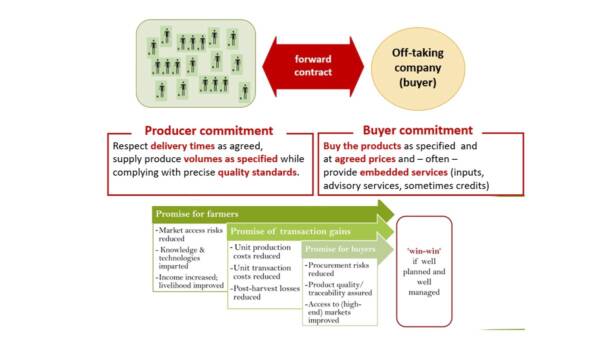
Contract farming is a mutual agreement. The farmer commits to growing high-quality rice and selling it to the miller. The miller, in turn, commits to buying that rice at an agreed price and often supports farmers with seeds, fertilizer, and training.
It moves the industry away from uncertain transactions on the open market toward a planned and professional partnership. To support this approach, the Market-Oriented Value Chains for Jobs and Growth in the ECOWAS Region project (MOVE) through its matching grant funds helped to turn these agreements into profitable realities for thousands of people.
Partnerships in practice
Across West Africa, MOVE has trained nearly 27,000 farmers in sustainable farming methods and business skills. Farmers benefit from higher yields, better quality produce, and the security of a guaranteed buyer through contract farming, while also gaining access to essential inputs.
Processors benefit as well. A steady supply of quality paddy allows them to keep their machines running and maintain a consistent presence of their brands on supermarket shelves. In Ghana alone, more than 120 formal contracts have already been signed, creating a new standard for how the rice business can be organised.

Wilfred Akapanga ⎮ Photo: © GIZ/MOVE
Reality Maker Limited, led by Wilfred Akapanga, previously struggled with supply-chain uncertainty. The company never knew whether the paddy bought on the open market would be clean, high quality, or even available.
“Inconsistent access to quality paddy once posed a major risk to our operations,” says Wilfred Akapanga. “We were constantly struggling to meet what our customers wanted.”
Through the MOVE project, Reality Maker shifted to an inclusive contract model. Instead of remaining only a buyer, the company became a partner to farmers, providing training in improved agricultural practices and conducting regular farm visits. The impact was immediate for the business: risk decreased. Knowing what was being grown and when allowed the company to plan production and meet market demand more reliably.
For farmers, the model provides new stability. They received input credit for seeds and fertilizer, access to warehouses to prevent spoilage, and, most importantly, a guaranteed market. As a result, many farmers are now producing more rice on less land while improving their income.
A blueprint for the future
The experience of Reality Maker shows that when trust-based partnerships are established, both sides benefit. Contract farming is not limited to rice value chains; the model can also be applied to other crops. When farmers and processors work together, they create a system in which both sides gain. To sustain this progress, supportive policies and financing mechanisms are needed to help partnerships grow.
To strengthen private sector actors in the rice value chain and promote a more market-oriented rice sector in West Africa, the MOVE project of GIZ has adopted contract farming mechanisms. These mechanisms aim to increase incomes for farmers and processors while strengthening the regional rice supply chain and contributing to greater rice self-sufficiency in West Africa.
Additional information
To support implementation and facilitation of the contract farming model, two handbooks and an ICT toolbox have been developed by GIZ. Available for download on the Contract Farming CoP page.
Contacts
| Issah Nadjo | issah.nadjo@giz.de |
| Cindy Osei Akoma | cindyakoma.osei@giz.de |
| Priscilla Winpoa Zangina | priscilla.zangina@giz.de |
