How Multi-Stakeholder Platforms Are Rewiring West Africa’s Rice Governance
What platforms linked to the ECOWAS Rice Observatory reveal about coordination, policy dialogue, and private-sector leadership in the rice sector
The Added Value of This Article
Hover over to have a look!Value add for readers
- How to use multi-stakeholder platforms to align governments, private sector actors, and development partners around shared sector priorities and coordinated action.
- How to design sector platforms with private-sector leadership, transparent governance, and member ownership to build trust and long-term institutional sustainability.
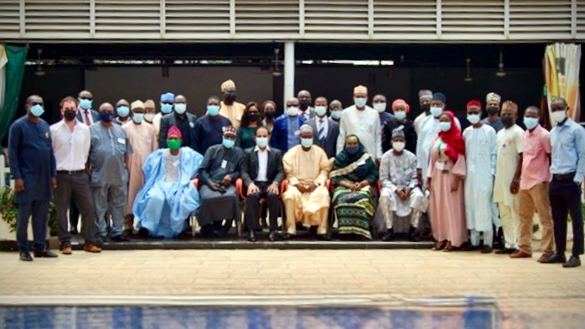
CARF-FSD – Nigerian Rice Chapter ⎮ Photo: © GIZ/MOVE
Across West Africa, rice production has increased substantially over the past decade. Yet despite this growth, the region remains heavily dependent on imports. The missing link is often institutional coherence. In many countries, agricultural policy remains fragmented, with public institutions, private investors, and farmer organizations operating in parallel rather than together. Improving the food system therefore also requires improving dialogue across the sector.
This is where the ECOWAS Rice Observatory and its national chapters play an important role. They provide platforms where actors across the rice value chain can exchange information, align priorities, and strengthen coordination.
Building a Hub for the Rice Sector
The ECOWAS Rice Observatory was established in 2021 by the ECOWAS Commission in a joint effort aimed at catalysing the growth of the West African rice industry. Its objective is to coordinate rice-related programmes, public and private investments, and policy recommendations for key decision-makers across the sub-region through a bottom-up approach.
To this end, the Observatory, together with development partners, supported the establishment of national multi-stakeholder platforms to drive the growth of the rice sector. Five national chapters have been fully established so far:
- In Ghana the Competitive African Rice Platform (CARP Ghana)
- In Nigeria the Competitive African Rice Forum for Sustainable Development (CARF-FSD)
- In Sierra Leone the Sierra Leone Rice Observatory (SLeRO)
- In Burkina Faso the Observatoire National du Riz Burkina Faso (ONARiz-BF)
- In Côte d’Ivoire the Observatoire National du Riz Côte d’Ivoire (ONRiz-CI)
Through these platforms, stakeholders can exchange information, align interventions, and jointly shape sector priorities. What was previously a landscape of largely uncoordinated initiatives increasingly becomes a space for structured dialogue and collaboration.
To facilitate the establishment of these national multi-stakeholder platforms, the Market Oriented Value Chains for Jobs and Growth in the ECOWAS Region Programme (MOVE) worked collaboratively with partners throughout the process, as illustrated below.
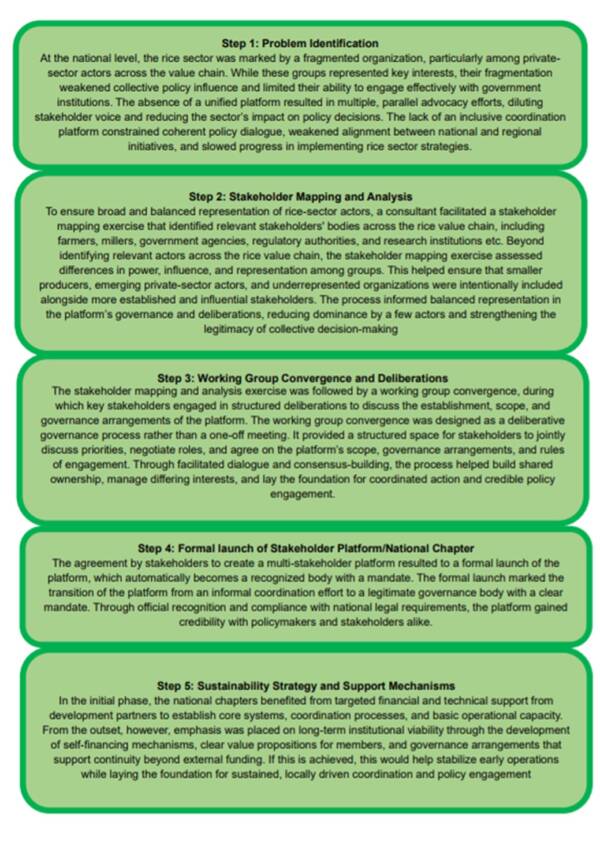
Joint process flow for establishing rice multistakeholder platforms ⎮ Graphic: © GIZ/MOVE
Strategic Shifts
Several strategic shifts have taken place as these platforms emerged: from isolated projects toward coordinated action, stronger private-sector participation, and institutions that stakeholders increasingly see as their own.
Strengthening Dialogue and Policy Alignment
One of the notable shifts created by these platforms is the stronger role of the private sector in policy dialogue. In many agricultural programmes, private actors participate primarily as beneficiaries. Within the national rice platforms, however, they increasingly contribute to shaping policy discussions. Their insights on market realities, trade flows, and investment constraints help inform more practical strategies for sector development.
When private sector actors assume leadership roles within these platforms, discussions move beyond requests for subsidies toward more data-driven exchanges about competitiveness, market development, and value chain performance. This dialogue is particularly relevant for regional trade policies affecting rice markets, including regulations governing cross-border trade and regional market integration.
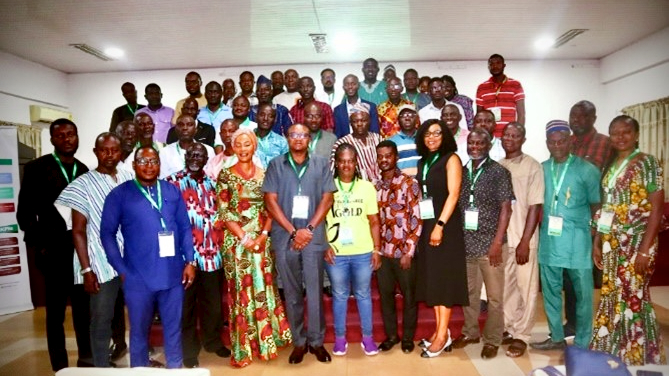
CARP Ghana – National working group ⎮ Photo: © GIZ/MOVE
Building the Hub of the Industry
Before these platforms, the rice sector was a collection of uncoordinated projects. The national chapters have helped create a hub for the industry. These platforms have turned fragmented voices into a more unified advocacy force. For the first time, stakeholders are aligning their own budgets and interventions with national roadmaps, reducing duplication and helping ensure that actors are working in the same direction. To facilitate the establishment of these national multi-stakeholder platforms, the MOVE programme worked collaboratively with partners throughout the process, as illustrated in chart on joint process above.
Elevating the Private Sector as a Policy Designer
One important shift has been moving the private sector from a passive recipient of aid toward a stronger role in shaping policy discussions. When these platforms are private-sector-led, the conversation changes from a wish list of subsidies to a more data-driven dialogue on market realities. This leadership helps ensure that regional trade policies — including those governing cross-border movements of rice — are practical, profitable, and sustainable.
The “Ownership” Dividend: Trust as a Resource
Sustainability is often discussed as a financial goal, but it starts as a social one. The approach focused on transparency in leadership and decision-making. Members were able to design their own governing boards and elect their own leaders. This helped reduce the perception of external project control and created a stronger sense of ownership among stakeholders. This trust helps ensure that the platforms remain relevant to their members even as external support gradually transitions.
Moving Toward Self-Governing Institutions
The ultimate measure of impact is institutionalisation. A platform becomes successful when it no longer feels like a project activity but rather a key part of the national economic infrastructure. As the national chapters mature, the focus is shifting toward developing a sustainable value proposition. This includes providing members with exclusive market data, access to policy discussions, and a seat at the table in regional trade dialogue. When the platform provides clear value to its members, stakeholders are more likely to invest in maintaining and strengthening the institution.
Similar approaches to multi-stakeholder coordination are also emerging in other regions. A recent SNRD Africa article on multi-stakeholder platforms in East Africa explores how comparable dialogue formats are helping align actors and strengthen governance in agricultural value chains.
The experience of the ECOWAS Rice Observatory shows that one of the most powerful innovations in agricultural development may not be technological but institutional: creating effective relationships between actors across the sector.
Contact
- Hamzat Olawale, olawale.hamzat@giz.de
- Cindy Osei Akoma, cindyakoma.osei@giz.de
- Nunana Addo, nunana.addo@giz.de
