The Experts Behind Africa’s Cashew and Rice Value Chains
How the MOVE master training programmes build regional expertise across farmers, markets and policy
The Added Value of This Article
Hover over to have a look!Value add for readers
- Understand why intermediary capacity is critical for food systems transformation
- Learn how Master Training Programmes strengthen coordination, markets, and inclusion across different value chains
- Gain insights into how tested training models can be replicated and adapted across diverse agricultural value chains
- See how regional programmes translate capacity building into jobs, competitiveness, and private-sector engagement
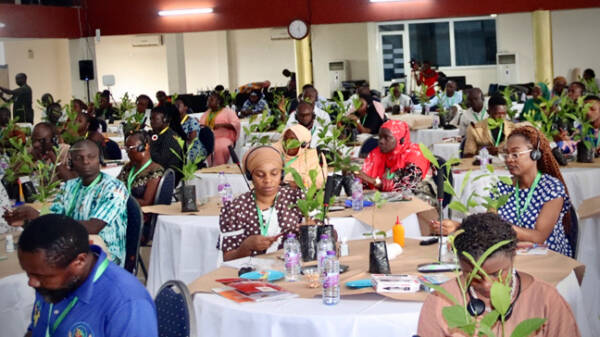
Participants during a session of the cashew master training programme ⎮ Photo: © GIZ
Across Africa’s cashew and rice sectors, the challenge is often not a lack of technology or ideas. The real bottleneck lies in coordination and expertise across the value chain. The Master Training Programmes supported by the Market-Oriented Value Chains for Jobs and Growth (MOVE) project address this gap by strengthening the professionals who connect farmers, markets and policymakers.
Transforming food systems in Africa is about more than just new seeds or tools. It is about people and how they work together. To truly succeed, we must strengthen the links between everyone involved—from researchers in the lab to farmers in the field and traders in the market.
When the people who support our farmers are well-trained and connected, the entire system works better. It leads to better nutrition, stronger communities, and more jobs. Yet, in many areas, a lack of coordination and limited private-sector involvement still hold progress back. This is why capacity building, investing in people’s skills, is at the heart of what we do.
How master training programmes connect farmers, markets and policy
The MOVE project, in collaboration with partners like the African Cashew Alliance and AfricaRice, implements the master training programmes. They go beyond your usual workshop set-up as they are a strategic way to solve real-world challenges in the cashew and rice industries.
The training programme brings everyone to the same table: farmers, processors, exporters, government officials, and researchers. Through the training of these intermediaries—the people who connect different parts of the industry—we ensure that the entire value chain functions more effectively and sustainably.
The cashew master training programme became a regional blueprint
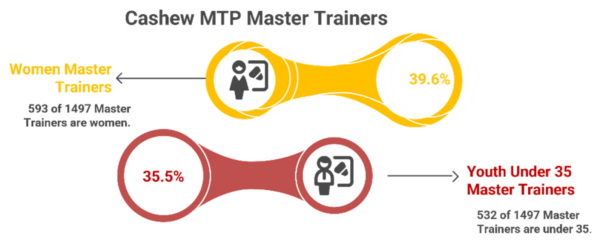
The cashew training programme has become a benchmark in the region. After 20 programme cycles, it has built a pool of experts across 20 countries.
Graphic: © GIZ/MOVE
What is different about it?
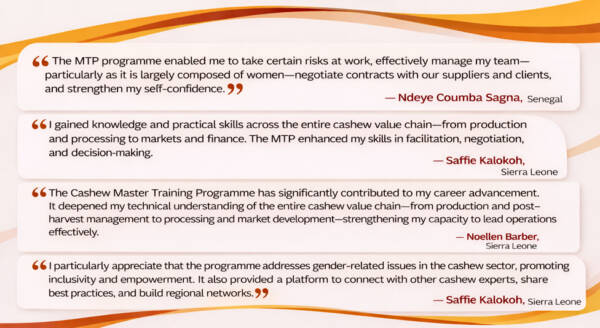
- It isn’t just theory, it’s practical learning. Participants spend time in the field, gaining the confidence to lead and negotiate.
- Participants apply what they’ve learned between the session periods, when they return to their home organizations to mentor others, pilot new solutions, and fix real problems on the ground.
- The programme focuses on women, it actively supports them. For example, it provides nannies for nursing mothers. Thereby it ensures that caregiving responsibilities don’t stop talented women from becoming industry leaders. A 2025 survey showed that nearly 7% of recent women graduates have already moved into higher-level leadership roles.
Graphic: © GIZ/MOVE
Adapting a proven model for rice self-sufficiency
Success is most powerful when it can be replicated. After perfecting the Master Training model in the cashew sector, MOVE is now applying that same expert-led strategy to rice, a crop that sits at the heart of Africa’s food security. Adapting a tested formula to the unique needs of rice farmers and millers, we are ensuring that the lessons learned in one field are used to feed millions more.
Launched in 2025, the Rice Master Training Programme was designed to tackle the specific hurdles of the rice industry: fragmented advice for farmers, weak links to the market, and a lack of local experts. This train-the-trainer approach brings together professionals from Ghana, Nigeria, Burkina Faso, Côte d’Ivoire, Senegal, and Sierra Leone to build a unified front for agricultural growth.
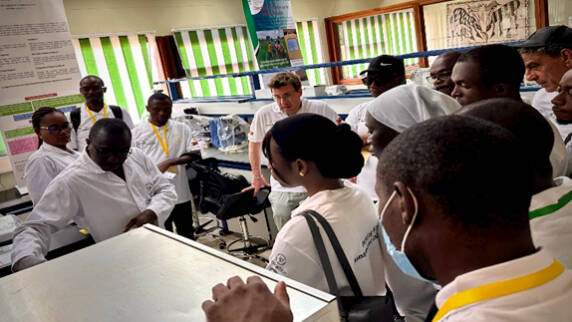
Field visit to AfricaRice research centre during a rice master training⎮ Photo: © GIZ/MOVE
What the rice master training achieves
- The training has a 360-degree view. It covers the entire journey, from rice market trends and better farming practices to the economics of milling and how to use rice by-products.
- It comes with hands-on impact. In between training sessions, participants work directly with farming groups. They document what works, mentor local stakeholders, and collect the data needed to make the sector smarter.
- It generates a new crop of leaders. The first cycle set a high bar for inclusion, with 64.5% women and over 60% youth participation.
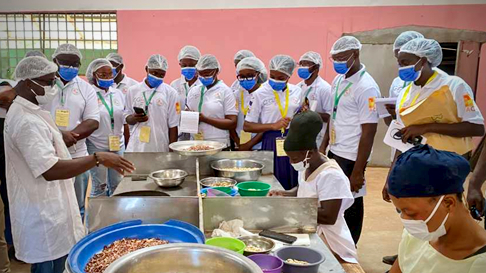
Field visit to a cashew processing facility during a cashew master training⎮ Photo: © GIZ/MOVE
Why expert knowledge is Africa’s greatest asset
At its core, changing food systems is about more than just seeds and soil. It is about the people who manage them. Through the professionalization of the roles of those who support our farmers and agribusinesses, MOVE is ensuring that the most valuable part of the value chain -expert knowledge- stays exactly where it belongs: within our borders.
This is not just about processing cashew or milling rice; it is about building a foundation that is resilient, efficient, and most importantly, driven by local expertise. When we invest in master trainers, we are creating a network that can handle shifting markets, solve local problems, and mentor the next generation.
Additional information
- Human Capacity Development (HCD)/Scaling – ComCashew
- Cashew Master Training Program – MTP | Cashew Master Training Program,
- AfricaRice and MOVE Launch Inaugural Rice Master Training Programme – CARI : Competitive African Rice Initiative
- RMTP | africarice-English
Contact
- Beate Weiskopf, Programme Lead-GIZ MOVE ComCashew, beate.weiskopf@giz.de
- Florian Winckler, Project Lead, florian.winckler@giz.de, GIZ MOVE CARI
