The Missing Piece in Nigeria’s Rice Sector: Stronger Milling Businesses
Training programmes help millers strengthen business management and operational practices, enabling local processors to better respond to Nigeria’s growing demand for rice
The Added Value of This Article
Hover over to have a look!Value add for readers
-
Understand why the milling sector is a crucial link in Nigeria’s rice value chain.
-
Learn how business management training helps millers improve efficiency and competitiveness.
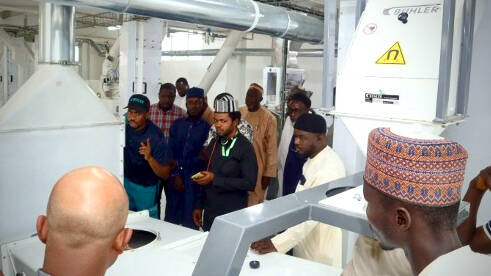
Grain Processing Innovation Centre in Kano State, Nigeria,
owned and managed by the Bühler Group ⎮ Photo: © GIZ
Nigeria consumes over 6 million metric tons of rice annually, yet a large production gap remains. The solution is not about growing more paddy. It is building better businesses. Through the Rice Miller Business Training, MOVE — the Market-Oriented Value Chains for Jobs and Growth in the ECOWAS Region project — is helping local processors bridge the gap from small-scale milling to professional enterprise.
Nigeria is a giant in West African rice production, yet the nation still relies on imports to fill its bowls. With national consumption exceeding 6 million metric tons and local production at roughly 5.34 million, the rice gap results in a foreign exchange outflow.
While the focus is often on farmers, the real bottleneck is frequently found at the mill. Small and medium-scale millers are the backbone of local food security, yet many struggle with the business of rice. Experience shows that new equipment alone is not enough; without solid record-keeping, clear pricing, and organized management, even the best mills struggle to scale. To achieve self-sufficiency, Nigeria doesn’t just need more millers. It needs business-minded managers.
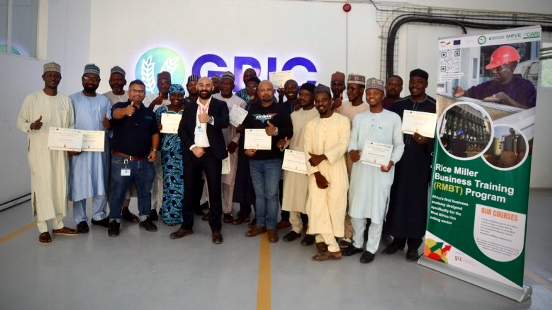
Participants during the Rice Miller Business Training training with Bühler group ⎮ Photo: © GIZ
The program focuses on five pillars that turn a mill into a sustainable company:
- Business of Rice Milling: Planning for long-term and short-term growth while looking at the investment benefit.
- Finance Essentials for Rice Mills: Improved planning, cash flow, systems, reporting and compliance
- Developing Profitable Farmer Services: sourcing quality paddy for an increased amount of raw material.
- Practical Marketing for Rice Mills: looking at the 6 Ps of marketing (product, price, place, people, process)
- Milling Operations (conducted by Bühler Group): Innovative technologies to optimize the milling process
Bringing the training into practice
The program, through the collaboration of GIZ-MOVE, Bühler, and Partners in Food Solution, consists of two different parts: The first part is the Rice Miller Business Training program that allows mill owners, mill managers and mill staff to improve their everyday management of the rice mill and deepen their knowledge on mill management. The second part is Business Development Support, which focuses on coaching and individual support to mills to operationalize what they learned in the courses.
Since joining the program, participating mills have reported a transformation in how they operate:
- Data-Driven Decisions: Pricing and buying are now based on cost analysis rather than guesswork.
- Access to Finance: With structured records and clear roles, millers now have the confidence and the documentation to approach financial institutions for expansion loans.
- Market Competitiveness: Improved organization leads to a more consistent, high-quality product that can compete with imports on supermarket shelves.
The New Standard: Building the Business Backbone of Nigeria’s Rice Industry
The success of Nigeria’s rice sector cannot be measured in bags alone; it must be measured in the resilience of its businesses. The business training programme demonstrates that sustainable impact requires more than a single technical intervention. It requires a holistic approach to the business of rice milling.
The MOVE project and its partners are ensuring that local mills do not just survive the current market but define it. These are no longer just milling points; they are becoming data-driven enterprises capable of creating jobs and securing food for millions.
This is the design for lasting growth. Millers are trained for both today and have the capacity to own Nigeria’s food future, ensuring that Made in Nigeria rice is a symbol of both quality and economic independence.
Contact
Florian Winckler, Project Lead, florian.winckler@giz.de, GIZ MOVE CARI
