What Makes Responsible Supply Chains Work in Practice
Experiences from pilot projects across Africa highlight the role of local partnerships, practical tools and long-term engagement in building sustainable agricultural value chains
The Added Value of This Article
Hover over to have a look!Value add for readers
- You will gain concrete, practice-based insights on how to embed risk assessment, digital traceability, grievance mechanisms, and gender-responsive approaches effectively in agricultural supply chains.
- You will understand the key success factors, trust, participation, context-specific design, and long-term engagement, that make due diligence work in real-world settings.
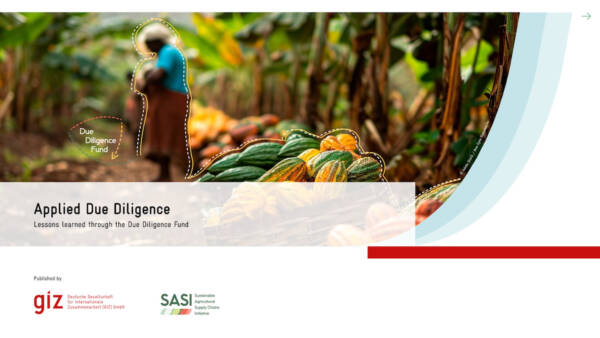
Cover of the report ⎮ Photo:© GIZ
Pilot projects supported by the Due Diligence Fund show how responsible supply chain principles can be implemented in practice. Experiences from agricultural value chains across Africa highlight the importance of participatory risk assessments, locally embedded grievance systems and gender-responsive approaches.
Translating due diligence commitments into meaningful change requires solutions that are grounded in real-world practice. The pilot projects supported by the Due Diligence Fund, a programme of the Sustainable Agricultural Supply Chains Initiative, demonstrate how companies, farmers and local institutions can work together to implement responsible supply chain approaches that respond to concrete risks and opportunities.
The report Applied Due Diligence consolidates lessons from the first 13 projects funded through the initiative. It shows how the foundational principles outlined in the United Nations Guiding Principles on Business and Human Rights and the OECD Due Diligence Guidance translate into practical requirements for companies and supply chain actors.
While the report takes a global perspective, many of the projects were implemented in African countries including Côte d’Ivoire, Sierra Leone, Ethiopia, Uganda and Malawi. This article highlights four case studies that illustrate how different approaches can strengthen due diligence implementation in agricultural value chains.
Embedding Due Diligence in Real Supply Chain Contexts
In Egypt, a project developed a participatory risk analysis tool to address key challenges in agricultural supply chains and to better integrate due diligence into company processes. Key issues identified included occupational safety risks, child labour and gender inequality.
At the time, companies lacked a practical tool for conducting participatory on-site assessments with suppliers that capture the complex factors often underlying adverse impacts. Using an iterative process that included desk research, field visits and interviews with managers, workers and farmers, the WÉCareAgri audit standard was developed.
The standard translates company codes of conduct into measurable indicators and provides practical templates for collecting data and planning corrective actions. Importantly, the materials are publicly available for second-party audits in the agrifood sector.
The process also resulted in practical improvements on the ground. For example, project partners implemented measures to improve worker wellbeing during extreme heat, including installing fans, air-conditioning units and rest areas.
A key lesson emerged: audits only lead to meaningful change when they are integrated into existing company processes, such as risk-based supplier selection and regular supplier visits coordinated with purchasing departments. At the same time, constructive business relationships and continuous dialogue are essential for making such processes voluntary and participatory.
Participation, Technology and Trust in Value Chain Transformation
Projects in Sierra Leone and Ethiopia focused on improving data management in cocoa, avocado and coffee supply chains. Weak data systems had made it difficult for companies to identify sustainability risks and sometimes discouraged sourcing from certain regions altogether.
To address this challenge, project partners developed an open-source data integration platform and dashboard that allows European buyers to meet due diligence requirements, particularly in relation to deforestation regulations and living income commitments. The platform consolidates sustainability data and integrates recognised standards such as Fairtrade and Rainforest Alliance.
Through this system, more than 22,000 farmers were digitally connected to markets, attracting strong interest from companies seeking reliable sustainability data. The tool’s code is openly accessible and partners are exploring its use in additional regions.
However, implementation also revealed important challenges. Low survey response rates highlighted the need to involve stakeholders more directly from the outset. Financial incentives for farmers proved difficult to maintain due to cocoa market volatility and the lack of mechanisms to ensure premiums reach individual farmers rather than cooperatives.
Another insight concerned gender data gaps, which limited the ability to design inclusive interventions. The experience demonstrates that digital tools can strengthen sustainability efforts, but only when they remain flexible, participatory and closely linked to local realities. Technology can support responsible supply chains, but it cannot replace relationships and practical implementation on the ground.
In Côte d’Ivoire’s cocoa sector, projects explored how grievance mechanisms could be redesigned to better reach smallholder farmers. Existing company systems often failed to capture complaints effectively and frequently required farmers to report issues multiple times.
The project therefore explored the creation of an accessible, co-created grievance mechanism compatible across companies. A feasibility study involved farmers, cooperatives, women’s groups, village leaders and local authorities.
Rather than introducing an entirely new structure, the proposed system builds on existing village and cooperative networks. Complaints can be submitted through multiple channels, including village focal points and phone-based reporting, allowing anonymity where needed. Independent oversight mechanisms are intended to ensure transparency.
The study concluded that such a system is both relevant and feasible, recommending a phased implementation beginning with a pilot phase before expanding more broadly.
The experience underlined a central insight: grievance mechanisms must be culturally embedded and based on trust. Awareness raising and capacity development are essential to ensure that farmers feel safe using the system. At the same time, grievance mechanisms alone cannot address systemic risks such as child labour or deforestation. They must be integrated into broader prevention and livelihood strategies, ideally supported by sector-wide collaboration facilitated by neutral actors.
In Malawi, another project addressed the absence of a certified organic groundnut value chain, which limited farmers’ access to higher-value markets and reduced transparency in supply chains.
Using the “Grown Farm Incubator” model, farmers received pre-financed inputs, irrigation technologies and training in organic and business practices. Gender-responsive elements were integrated from the outset, including financial literacy training tailored for women, confidence-building measures and dedicated participation spaces.
Although a severe dry season and pest infestation limited short-term income gains, the project successfully trained 100 farmers, including 60 women, and initiated organic certification processes. Women assumed leadership roles, acted as peer trainers and became more visible in decision-making structures within their communities.
The experience demonstrates that gender equality does not emerge automatically from market integration. It requires deliberate design, targeted resources and sustained support. When women gain access to knowledge, assets and leadership roles, value chains can become more inclusive and resilient.
From Project Lessons to System Transformation
Taken together, these experiences underline a simple but important insight: transforming food systems cannot be engineered from the outside. Sustainable change emerges when farmers, cooperatives, companies and local institutions work together to identify risks and develop practical solutions.
Across the projects, several common principles became clear. Risk assessments must be tailored to local contexts rather than applied through generic tools. Digital systems can strengthen transparency, but they only succeed when they remain flexible and connected to real supply chain relationships. Grievance mechanisms must build on existing community structures and be trusted by those who are expected to use them. And efforts to strengthen women’s participation require deliberate design and long-term commitment.
These lessons highlight that responsible agricultural supply chains are not created through compliance alone. They develop through trust, collaboration and continuous learning across all actors in the value chain.
Additional Materials
- Read the full report: Applied Due Diligence – Lessons learned through the Due Diligence Fund
- Learn more: Due Diligence Fund – Sustainable Agricultural Supply Chains Initiative
Contact
Johannes Luderich, Coordinator, Due Diligence Fund, johannes.luderich@giz.de
Upcoming training events
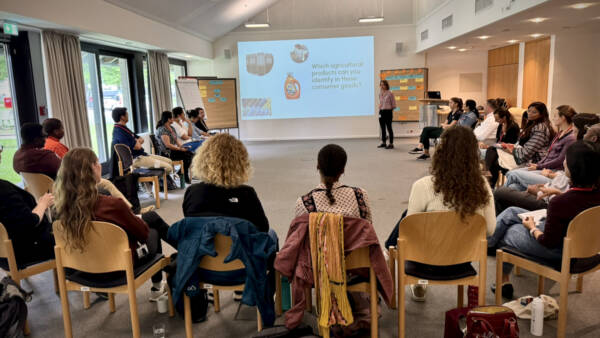
SASI training in 2025 ⎮ Photo:© GIZ
Participants will gain deeper technical and practical insight into the focus topics:
- Governance in Agricultural Supply Chains / Smart Mix
- Forests and Deforestation
- The German and European Due Diligence regulations incl. EUDR and CSDDD
- Living Income & Wages
- Digital Traceability and Satellite Monitoring,
- Broader Systemic Approaches
👉 Register now on our website for the training in Abidjan (in French) or Bonn-Röttgen (in English) and share the training with your network.
More general information about the SASI Training here.
Contact: Andrea Bruestle, andrea.bruestle@giz.de, OE 510, Sector Project Sustainable Agricultural Supply Chains (SV NA)
