Beekeeping for Mangroves and Livelihoods
In coastal Kenya and Tanzania, beekeeping is proving to be more than honey. It’s a pathway to healthier mangroves, stronger incomes, and new opportunities for women
The Added Value of This Article
Hover over to have a look!Value add for readers
🌍 Nature-based solutions in practice: Learn how apiculture directly supports ecosystem conservation while creating livelihoods
👩🏽🌾 Breaking barriers: See how women are entering the beekeeping sector, diversifying incomes, and strengthening communities
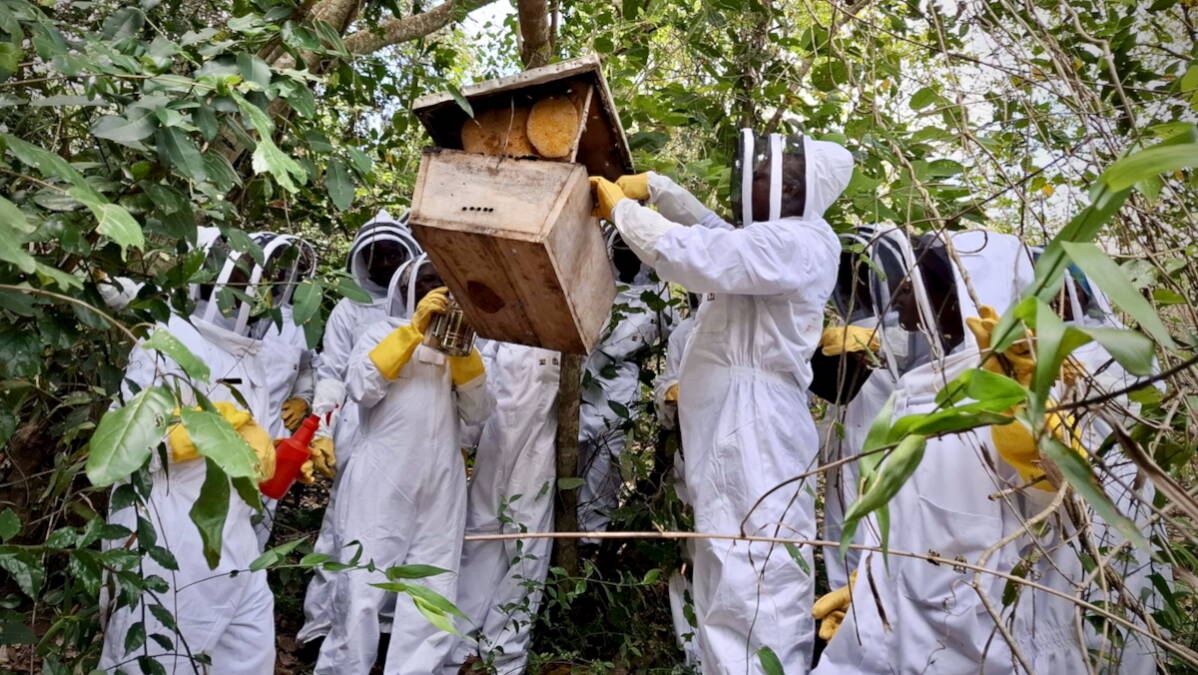
Members of the community beekeeping group during the apiculture training ⎮ Visual: © GIZ
What connects bees to mangroves?
In Kwale, Kenya, and Mkinga, Tanzania, communities are showing how sustainable apiculture can protect fragile coastal ecosystems while creating new income opportunities—especially for women.
Through training and support, local groups are learning how to turn beekeeping into a driver of both conservation and livelihoods. The approach demonstrates that nature-based solutions can provide tangible benefits for people while safeguarding biodiversity.
From hives to honey — and beyond
The training unfolds in two phases. First, participants learn the essentials: hive construction, colony management, and honey production. Later, they move into harvesting, hygiene, and value addition—from beeswax candles to creams and lip balms. Local carpenters are trained to build improved hives, ensuring a sustainable supply of equipment, while extension officers provide ongoing technical support.
Early results are encouraging. The Tunusuru beekeeping group, for example, improved yields from 14 kg of unripe honey to 25 kg of high-quality honey with just two hives. Women are stepping into the sector too—21 so far—breaking cultural barriers and diversifying household incomes. Altogether, communities are now producing seven different bee-based products, opening doors for entrepreneurship and stronger local markets.
Four building blocks for success
Behind these results is a structured approach combining conservation with economic opportunity:
-
Value Chain Analysis: Mapping the mangrove honey sector to identify challenges and interventions, such as better hive ownership and market access.
-
Carpenter Training: Building local skills to produce improved hives, ensuring quality and creating new business.
-
Training of Trainers (ToT): Equipping beekeepers, women, youth, and extension officers to share sustainable practices more widely.
-
Value Addition: Supporting product development beyond raw honey, using local materials to expand income opportunities.
Together, these four elements create a stepwise model that strengthens both ecosystems and communities.
Why it matters
By linking beekeeping with mangrove protection, this initiative shows how climate action can work on two levels: conserving vital ecosystems and creating viable, dignified livelihoods. The experience in Kwale and Mkinga offers a replicable example of how communities can adapt, thrive, and protect their natural environment.


Left to right: Jointly harvesting honey from improved beehive, harvesting from honeycomb attached to the bar of an improved beehive; learning about safety and appropriate beekeeping suits ⎮ Photos: © GIZ
Additional information
Gender-Inclusive Apiculture for Mangrove Protection and Livelihoods in Kwale and Tanga | PANORAMA
Contact
- Simon Chuchu, simon.chuchu@giz.de
- Nelson Mdogo, nelson.mdogo@giz.de
