Community-Based Management and Fisheries: An Approach to Sustainable Growth
Paper to help communities navigate toward sustainable use of aquatic resources and empower fisher livelihoods
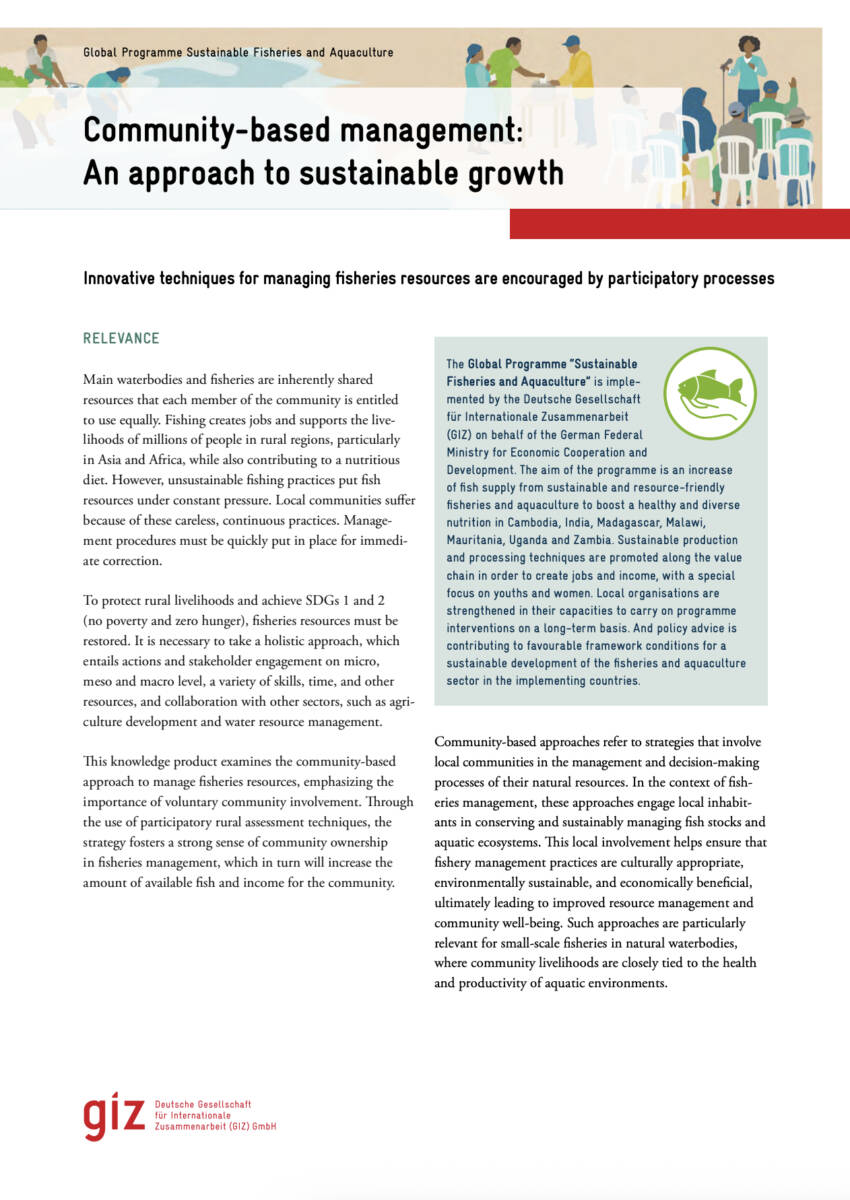
Cover of the publication ⎮ Download
Many rural communities across Asia and Africa rely heavily on local waterbodies for their food security and livelihoods — yet overfishing, weak governance, and lack of local ownership continue to degrade fish stocks and ecosystem health. Top-down management approaches often fail to reflect local realities, limiting their long-term impact.
This paper is for practitioners, local authorities, NGOs, and policymakers aiming to implement community-led fisheries management systems. It provides step-by-step guidance on how to establish, train, and support locally elected management committees, strengthen cooperation with government actors, and ensure transparent, sustainable resource use.
Through participatory methods, practical tools, and real-world case insights, the knowledge product empowers stakeholders to co-develop inclusive, accountable, and resilient governance structures that deliver measurable ecological and social outcomes.
About the Programme
By 2050, the world’s population is expected to reach nine billion people, resulting in increased demand for food and jobs. Thanks to the nutrients they contain, fish products are a means of combating undernourishment and malnutrition. They help to secure the livelihoods of millions of families. However, illegal, unreported and unregulated fishing is depleting fish catches and contributing to economic losses. There is a lack of legal framework conditions, access to high-quality resources such as feed and technical knowledge regarding sustainable fish production and processing.
Objective
The population facing food insecurity has access to more fish products and higher incomes derived from sustainable and resource-friendly fisheries and aquaculture.
Approach
‘More fish, more work’: the project advises small and medium-sized businesses on sustainable fish production and processing. This creates jobs and income-generating opportunities in the value chain. Innovative production methods cut costs and reduce after-catch losses.
‘Sustainable fish’: the project also advises the governments in its partner countries on planning and implementing strategies, action plans and other measures. In this way, it contributes to providing the necessary framework conditions for resource-friendly, artisanal fishing and aquaculture.
‘Less fish from IUU fishing’: IUU fishing is to be curbed by introducing registration and licensing systems for fishers and their boats and by conducting inspections.
The European Union supported the project until September 2022 with a cofinancing arrangement to develop and implement hygiene standards in the fish value chain in Mauritania.
In addition, the project cooperated until March 2022 with the non-governmental organisation Stop Illegal Fishing to support partner countries in implementing the Agreement on Port State Measures (PSMA) of the Food and Agriculture Organization of the United Nations.
Contact
Friederike Sorg, friederike.sorg@giz.de
